In industrial engineering we fall easily into the trap of focusing on the physical build — the steel, the wires, the machines. But the hard-won truth from the plant floor is this: a reliable operation is not a structure you build once and walk away from. It is a living system you have to sustain.
The House of Technical Health makes that visible. A house survives on three distinct layers: foundations that are unseen but carry the weight, a sturdy structure of load-bearing walls, and a roof that protects the whole investment. Ignore the ground beneath you or the alignment of the walls, and the roof — your production and your safety — eventually comes down on a midnight shift.
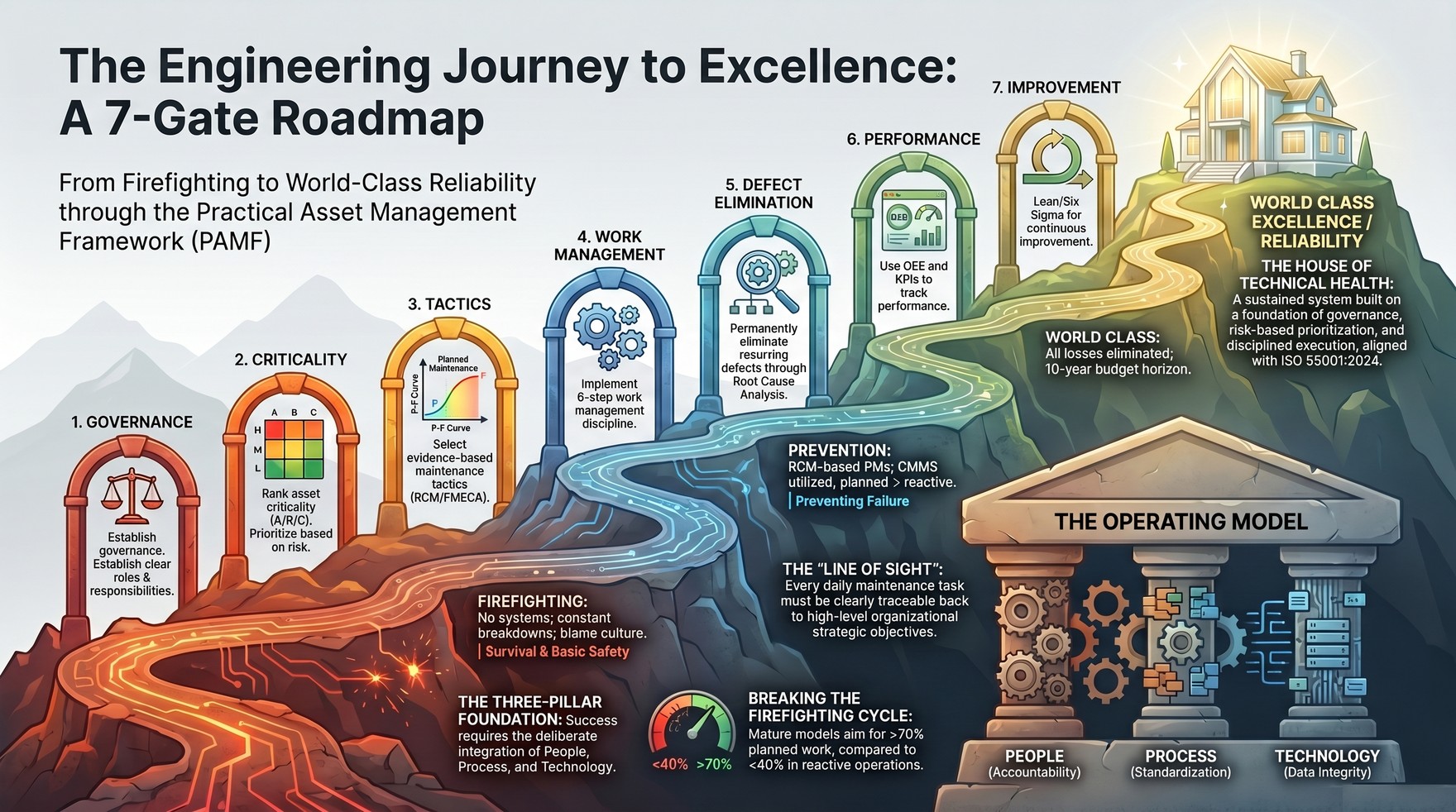
The House of Technical Health — outcomes on the roof, seven gates as the walls, the Operating Model as the foundation, sustainment as the ground it all stands on.
The roof — four outcomes of excellence
The roof is the visible result of a healthy operation. In the NJN framework, excellence is four measurable outcomes that must hold up at the same time. Hit production but hurt someone, or run safely at double the industry cost, and the house is tilting.
| Outcome | The standard | Why it matters for reliability |
|---|---|---|
| Production | Delivering the planned rate, tonnage and specification. | Unreliable assets create gap-to-plan problems that destroy business credibility. |
| Safety | Zero recordable incidents, injuries or fatalities. | Unplanned work is inherently unsafe. A reliable plant is, by definition, a safer plant. |
| Cost discipline | Operating cost per unit at or below top-quartile. | Reliability eliminates the “hidden factory” of emergency spending and waste. |
| Compliance | Full alignment with regulatory and ISO 55001:2024 standards. | Compliance is your licence to operate — without it, the business has no future. |
The foundation — the Operating Model
Before the first maintenance tactic is selected, there has to be a foundation: the Operating Model. Its job is to establish Line of Sight — a clear, traceable connection from board-level strategy down to the daily task of a technician on the floor. It rests on three things:
- Clear accountability (the RACI matrix). It ends the “everyone’s job is no one’s job” syndrome. Define exactly who is accountable and responsible for each task, and the confusion that causes missed inspections disappears.
- The six-step discipline. A standard workflow for planning and execution that removes the ~20% of waste caused by poor work preparation — parts, tools and people arriving at the machine at the same time.
- A single version of the truth. Decisions made on accurate CMMS data (SAP PM) rather than gut feel, so the operation moves in one direction instead of following the loudest voice in the room.
Read more in Book 1 — The Operating Model →
Why heroics fail
Reactive plants celebrate heroics — the technician who stays up 36 hours to fix a catastrophic failure. Admirable, but heroics are a sign of system failure. A world-class operation replaces the Hero with the Designer: the Hero saves the day with a wrench; the Designer makes the system robust enough that the day never needs saving. A systematic operation delivers the same result regardless of who is on shift.
This is its own case study: why every plant breeds a “Butch” — and why reliability needs you to retire him →
The load-bearing walls — seven gates to maturity
The structure of the house is seven gates, passed in sequence — the load-bearing walls of the operation. Each is a transformation, a tool, and a book.
Establishing governance — Operating Model
Shift: from individual heroics to a systematic operation. Tool: the RACI matrix.
Knowing what matters — Asset Criticality
Shift: from treating all assets equally to focusing on what creates risk. Tool: risk-based criticality (Class A / B / C).
Choosing the right maintenance — Maintenance Tactics
Shift: from maintaining on habit to maintaining on evidence. Tool: RCM and the P-F curve.
Executing the work — Work Management
Shift: from chaotic execution to predictable, value-adding work. Tool: the six-step work-management process.
Eliminating recurring defects — Defect Elimination
Shift: from re-fixing the same things to fixing them once, permanently. Tool: Root Cause Analysis and the 5 Whys.
Knowing it’s working — Performance Management
Shift: from hoping it’s working to knowing it’s working. Tool: the three-tier OEE framework (Availability, Performance, Quality).
Continuous improvement forever — Lean & Six Sigma
Shift: from a stable system to a continuously improving one. Tool: DMAIC (Define, Measure, Analyse, Improve, Control).
From tactical to systemic
Moving through the gates is more than a checklist — it is a mental shift. You move from a tactical mindset (fixing parts on a Monday morning) to a systemic one (managing risk). Early on you feel like a firefighter. By Gate 7 you feel like an architect. You stop asking “how do I fix this?” and start asking “how do I remove this failure mode from my reality for good?”
Sustainment — turning a structure into a living system
Even a perfectly built house crumbles if it isn’t maintained. In reliability we call the slow, near-invisible slide back into reactive habits drift. Book 8 — Integration, People & Sustainment — is the layer that stops the house collapsing. World-class operations hold the line on three things:
- Cross-functional integration. Maintenance, Production and Supply Chain run as one team. Integrated scheduling means Production owns the equipment and Maintenance owns its health.
- Human capability. Technicians are empowered as the first line of reliability engineering at the coal face — not just turning wrenches.
- Sustainment discipline. A drift-detection KPI set that lets you “hear the house creaking” — leading indicators like PM compliance and backlog trend that flag slipping standards months before a catastrophic failure.
Read more in Book 8 — Integration, People & Sustainment →
The reliability mindset
The House of Technical Health is not a destination — it is a way of operating. Whether you’re an engineer, a planner or a plant manager, you are a caretaker of the system:
- Think systems, not parts. A broken part is usually a symptom of a broken process.
- Respect the Line of Sight. Every daily task should connect to the safety and production goals on the roof.
- Triage with criticality. Don’t let Class C assets distract you from the Class A risks that can stop the site.
- Hunt the eight wastes. DOWNTIME — Defects, Overproduction, Waiting, Non-utilised talent, Transportation, Inventory, Motion, Extra-processing.
- Detect the drift. Use drift-detection KPIs to stay disciplined even under the pressure to “just get it running.”
- Fix it permanently. Never settle for a temporary fix — the goal is that the defect never returns.